
Sting's tunes, with a class-ical twist...
It's not every former punk rocker who can offer you an intimate, sultry summer's evening by the lake with his favourite orchestra.
But Sting is not your average former punk rocker. In a career that now spans 3½ decades, the son of a Newcastle upon Tyne milkman has shown himself to be an unusually versatile and adventurous musician.
After a recent foray into the 16th-century world of English composer John Dowland, as well as a tour with his old band, the Police, the man once known as Gordon Sumner has organized the ultimate in retrospectives. With a twist.
Sting has ordered up three-dozen orchestral arrangements from his Police and solo catalogues, going back as far as 1977. He is performing two dozen on each stop in a massive North American tour that launched in Vancouver last month.
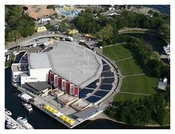
''This is the biggest band I've ever had in my life,'' declared a beaming Sting on Friday night, as he stood in front of 45 members of England's Royal Philharmonic Orchestra and veteran pop conductor Steven Mercurio, at the Molson Amphitheatre at Ontario Place.
Dressed in a tailored, buttoned-up black jacket for the first half, and comfortable loose white cotton shirt after intermission, Sting was clearly having a great time.
The artful musical arrangements gave the evening a whiff of nostalgia, casting the singer as seasoned balladeer and amiable storyteller. Besides the orchestra, there was able backup vocal help from Jo Lawry and guitarist Dominic Miller, as Sting crooned a wry 'Englishman in New York', 'Roxanne', 'Straight to My Heart', 'When We Dance' and 'Russians', among other favourites.
The moms in the audience - a cross-section of every demographic you can imagine - sang along or screamed as loudly as their daughters and granddaughters might at the sight of Justin Bieber.
Except that this concert was came off with infinitely more class.
It is not unusual to see symphonic musicians backing up pop acts such as Josh Groban or Il Divo. But you don't often hear arrangements that take full advantage of all the sounds and textures strings, woodwinds and brass can bring to a concert.
Founded in 1946, the Royal Philharmonic has long made a point of bringing classical music to a broader audience. The 45 members on tour with Sting are only part of the full orchestra, which also plays a season of summer concerts back home.
The sound system at the Molson Amphitheatre was turned down to showcase the orchestra's abilities - except for the one piece, 'Russians', which was meant to showcase its power. Opening with a portentious excerpt from Modest Mussorgsky's opera Boris Godunov before morphing into a quotation from composer Sergei Prokofiev, the Royal Phil's blasts were cranked up electronically, distorting them beyond recognition.
At other moments, individual clarinet, cello and violin solos were given their full due, with Sting stepping out of the spotlight to give the classical musicians a chance to shine - and rack up substantial cheers from the audience.
(c) The Toronto Star by John Terauds
Sting at his best with a symphonic twist...
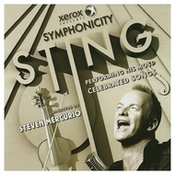
After listening to Sting's so-so new album, 'Symphonicities', I wasn't convinced about the symphonic treatment of his songs, both as frontman for British New Wave act The Police and later as a solo pop artist who experimented with jazz, Arabic, Latin, and country music.
But then I went to see him at the Molson Canadian Amphitheatre on Friday night with the Royal Philharmonic Concert Orchestra, conducted by the incredibly physical Steven Mercurio, plus a five-piece band including celebrated Argentinian-British guitarist Dominic Miller, and the appeal in a live setting became much more apparent.
The visuals definitely helped.
Looking yoga-enthusiast slim in a pair of tight black jeans, a black jacket with velvet cuffs, and closely cropped darker coloured hair, the 58-year-old Sting came out swinging with a strong first set before the intermission and a slower verging on sleepy second set until it thankfully picked up at the end again.
Performing on a slick-looking stage dominated by three large rotating panels on to which different coloured lights, videos and imagery were projected, he opened with the winning trio of 'If I Ever Lose My Faith In You', 'Englishman In New York' and 'Every Little Thing She Does Is Magic'.
''The brass section have their own choreographed dance moves,'' said Sting of the horn players who were hamming it up during 'Englishman In New York' including one kissing another on the cheek at the end of the song.
It was when Sting tried to perform the first real punk song, 'Roxanne', with the orchestral backing, that the formula didn't quiet gel.
That would prove true later in the evening with the country song, 'I Hung My Head', and another punk tune, 'Next To You'.
Still, more often than not, it did work and wonderfully on such highlights as the Latin-tinged 'Straight To My Heart', 'Shape Of My Heart', and Fragile; the ballads 'When We Dance', 'You Will Be My Ain True Love' (an Oscar nominee from the Cold Mountain soundtrack) with nice vocal work from backup singer Jo Lawry; the mid-tempo 'Russians', 'Whenever I Say Your Name' (with Lawry filling in nicely again for Mary J. Blige), 'Fields of Gold', and the evening's three later standouts 'King Of Pain', 'Every Breath You Take', and the Arabic-soaked 'Desert Rose'.
Whether he was shaking his tiny hips, belting out a long note that turned his face red, or relaxing with one arm on his mic stand, Sting exuded confidence throughout the night and often told funny stories about writing songs.
''There's two kinds of love songs. The first kind, I love you, you love me. The second kind, I love you, but you love someone else. It's painful but it's interesting,'' he joked.
And on writing a country song, 'I Hung My Head', after being obsessed with TV westerns like Gunsmoke and Bonanza as a kid, he said self-deprecatingly: ''I had authenticity issues. I'm from Newcastle.''
Still, Johnny Cash later covered the song.
Sting also got pretty personal about writing 'Why Should I Cry For You?' about his milkman father who died 25 years ago.
''He was a tough old bird,'' said Sting. ''My ancestors were seafarers and shipbuilders. One day he took me down to the shipyard and said, 'When you leave school, go to sea.' He wanted me to have an exciting life. Of course, I disappointed him.''
Hardly.
(c) The Toronto Sun by Jane Stevenson
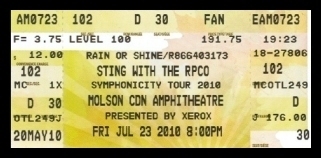
July 23, 2010
SET LIST
- If I Ever Lose My Faith In You
- Englishman In New York
- Every Little Thing She Does Is Magic
- Roxanne
- Straight To My Heart
- When We Dance
- Russians
- I Hung My Head
- Shape Of My Heart
- Why Should I Cry For You?
- Whenever I Say Your Name
- Fields Of Gold
- Next To You
- A Thousand Years
- Tomorrow We'll See
- Moon Over Bourbon Street
- End Of The Game
- You Will Be My Ain True Love
- All Would Envy
- Mad About You
- King Of Pain
- Every Breath You Take
- Desert Rose
- She's Too Good For Me
- Fragile
- I Was Brought To My Senses
PHOTOS